Textiles
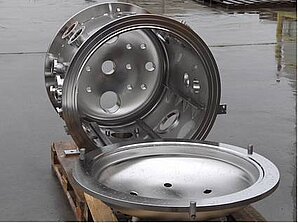
In the textile industry, in addition to bleaching agents, a range of dyes is also used – all of which are boiled together with the textiles in a water bath. Under the influence of high temperatures, the bleaching acids cause pitting corrosion. Furthermore, pigments easily become lodged in scratches and surface irregularities, resulting in a dull appearance that is impossible to clean.
Electropolishing solves all these problems:
scratches are eroded away and the protective layer of chromium oxide is strengthened. The treated surface can now be cleaned easily and thoroughly, and resistance to pitting corrosion is maximised.
In the dyeing departments of textile companies, significant savings are therefore made on cleaning costs by using electrolytically polished mixing vats. And unlike mixing vessels that have become tarnished, the optimal resistance to pitting corrosion guarantees the durability of the production facility.
Furthermore, electrolytic deburring of looms and textile machinery prevents the very fine textile threads from breaking.
Recommended treatments: electrolytically polishing or mechanically polishing to the desired surface roughness, pickling and passivation.